AI for franchise networks: the white-label playbook
Franchise networks have the hardest AI problem: one brand voice, many locations, varying capability. Three patterns that scale without losing the local touch.
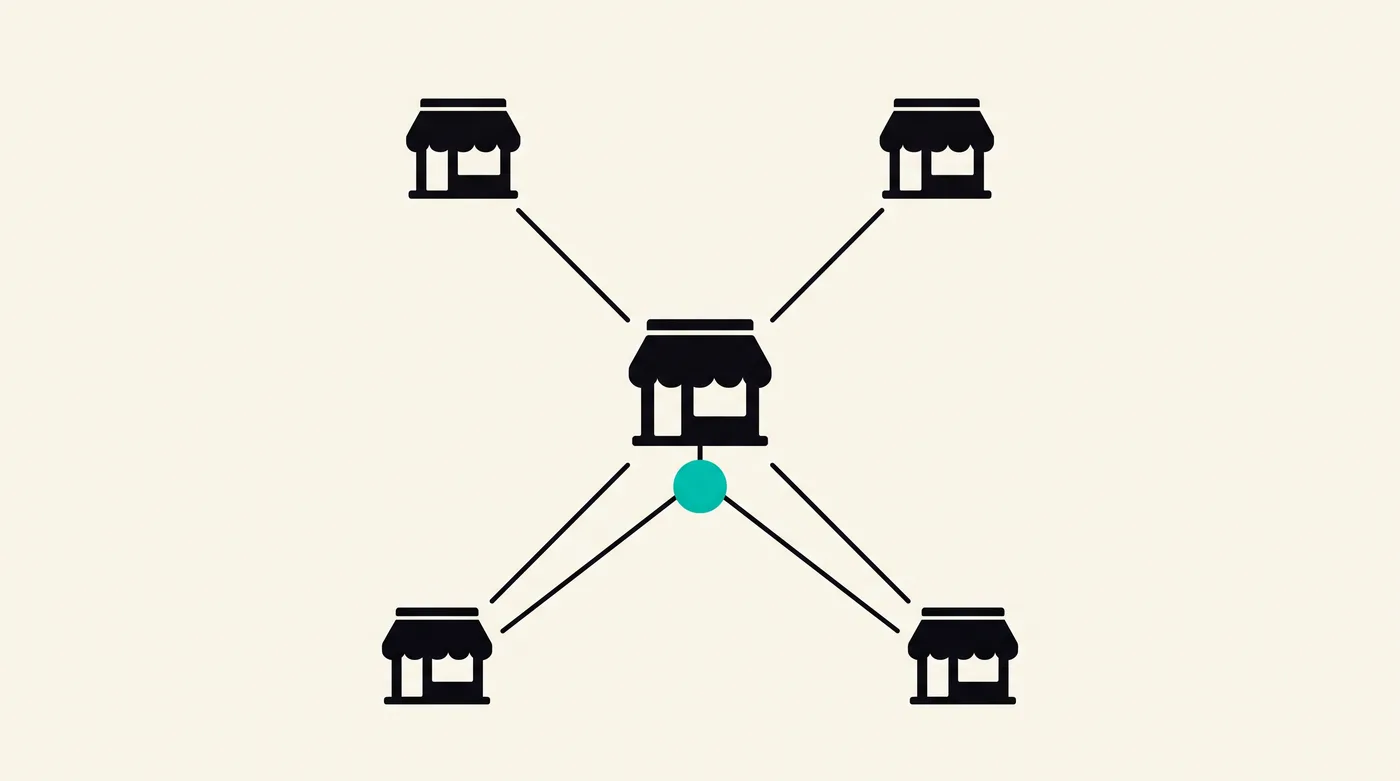
- Franchise networks face a hard problem: brand consistency at scale across operators with varying capability.
- AI is the lever that lets every location punch above its local capability — without making them all feel the same.
- Three patterns work: brand-voice templates with local context, central knowledge with local search, and head-office observability without micromanagement.
- Our products are multi-location by design — the same shape underneath Xwits Health Care's multi-branch clinics.
Franchise networks have the AI problem on hard mode: one brand, dozens or hundreds of locations, each with varying operator capability. Below is what works.
The three patterns
1. Brand-voice templates with local context
Head office defines the brand voice + the message catalogue (welcome messages, post-visit thank-yous, festival greetings, promotions). AI personalises each per location: local festival timings, regional language preference, neighbourhood-specific details.
Result: every outlet sends communications that feel both on-brand and locally relevant. The franchisee does not have to be a copywriter; they just approve.
2. Central knowledge with local search
The franchise has a master playbook: SOPs, training, troubleshooting, recipes (for food), service protocols (for services), product specs (for retail). New franchisees usually cannot find what they need fast.
AI search across the playbook + the franchisee's specific context (location, role, current issue) surfaces the right answer in seconds. The senior franchisee's tribal knowledge becomes available to every new outlet.
3. Head-office observability
HQ usually finds out about an outlet's problem at the next quarterly review — three months too late. AI watches the metrics across the network: footfall, conversion, NPS, complaints, staff turnover. Flags outliers + draft remediation suggestions.
Done well, this is supportive (HQ reaches out to help) not surveillance-y (HQ punishes the franchisee). The framing matters; the data is the same.
The white-label question
Many franchise networks want a white-label version of the AI tools — under their own brand, with their own colours, their own domain. This is a different product shape than B2C SaaS.
Three requirements:
- Theming. Every visible surface (web, mobile, email, SMS) carries the franchise's brand, not the vendor's.
- Multi-tenant isolation. Each franchise network is its own tenant; even within a franchise, each location is its own sub-tenant. See multi-tenant AI architecture.
- Custom workflow modules. Each franchise has unique workflows. AI must adapt to them, not impose a generic model.
The franchisee skill-gap problem
Franchise networks span operator capability from "first-time entrepreneur" to "veteran multi-unit owner." AI features must work for both ends:
- For the first-time franchisee: heavy guardrails. AI does most of the work. Franchisee approves.
- For the veteran: heavy customisation. Franchisee overrides defaults; AI learns their preferences.
One UX cannot serve both well. Multi-track AI features matter.
The performance benchmarking trap
AI makes it easy to rank outlets — and that is exactly the trap. Public outlet ranking damages morale at the bottom and creates perverse incentives at the top (gaming metrics, hiding issues).
Better: surface patterns confidentially. HQ sees the rankings; franchisees see their own number + the network median. Conversation is supportive, not competitive.
What to measure (network-level)
- Brand-voice consistency. Audit a sample of outlet communications quarterly. Are they on-brand?
- Time-to-answer at outlet level. When a franchisee has a question, how fast do they get the right answer?
- Outlet NPS distribution. The spread matters more than the average. AI should compress the spread by lifting bottom outlets.
- New-franchisee ramp time. Should drop with AI-assisted training + playbook search.
- HQ team load. Less reactive firefighting on outlet issues; more proactive support.
What this means for you
- Franchise AI is about lifting the bottom, not pushing the top.
- Three patterns: brand voice with local context, central knowledge, head-office observability.
- White-label requires theming + multi-tenant isolation + custom modules.
- Multi-track UX matters — first-time franchisees and veterans need different defaults.
- Skip public outlet rankings. Use AI for support, not surveillance.
- For specific industries: AI for gyms, AI for salons, AI for restaurants.
Running a franchise network? Book a 30-minute call. We will walk through your network's specific shape.
Related from the blog

AI for gyms: how a fitness business actually uses AI
Member churn, no-show classes, billing recovery, paper signups. Practical AI fixes for gyms, studios, and franchises — what works, what does not.

AI for salons: virtual try-on, smart booking, and quiet marketing
Salons live or die by walk-ins, retention, and the right stylist on the right day. Here is how AI helps with each — without the gimmicks.

AI for Tier 2 and Tier 3 Indian SMBs
Slow connectivity, mixed device quality, regional languages, paper-first workflows. What AI must do differently in Tier 2 and 3 India to actually work.
Talk to a real engineer.
A 30-minute call. We will tell you honestly whether AI is the right fix and what it would take.